
A two-firm Cournot problem with different marginal costs — try it before opening the solution.
Two firms produce a homogeneous good. Inverse market demand is
\[ \begin{aligned} p^d(q) = \begin{cases}12-q & \text{if } q ≤ 12 \\ 0 & \text{if } q > 12 \end{cases} \end{aligned} \]Firm \( 1 \) has constant marginal cost \( c_1 = 1 \) and firm \( 2 \) has constant marginal cost \( c_2 = 2 \). The firms compete in quantities, choosing \(q_1\) and \(q_2\) simultaneously.
Find the Nash (Cournot) equilibrium quantities \( (q_1^*, q_2^*) \), the market price, and each firm’s profit.
Hint
Each firm maximizes its own profit taking the rival’s quantity as given. Write firm \( i \)’s profit, find a best-response function in \( q_j \). Two best responses, two unknowns.
Solution
For \( q = q_1+q_2 \in [0,12] \), inverse demand is \( p = 12-q \). Firm \( 1 \) chooses \( q_1 \in [0, 12-q_2] \) to maximize
\[ \pi_1 = \big(12-(q_1 + q_2)-1\big)\, q_1. \]when \( q_2 < 12 \).
The first-order condition gives the best-response for the case \( q_2 < 11 \):
\[ \begin{aligned} 11-2q_1-q_2 &= 0 \\ \Rightarrow\quad q_1 &= \frac{11-q_2}{2}. \end{aligned} \]For \( q_2 \ge 11 \), its best response is to choose \( q_1 = 0 \).
So, the best response function of firm 1 is
\[ \begin{aligned} \text{BR}_1(q_2) = \begin{cases} \left\{\dfrac{11-q_2}{2}\right\} & \text{if } q_2 < 11 \\ \{0\} & \text{if } q_2 \geq 11 \end{cases} \end{aligned} \]Similarly, the best response function of firm 2 is
\[ \begin{aligned} \text{BR}_2(q_1) = \begin{cases} \left\{\dfrac{10-q_1}{2}\right\} & \text{if } q_1 < 10 \\ \{0\} & \text{if } q_1 \geq 10 \end{cases} \end{aligned} \]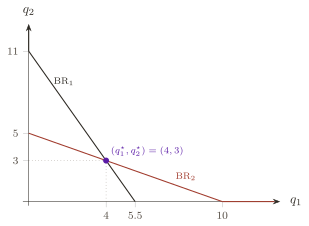
Solving the two best responses simultaneously:
\[ q_i^* = 4, \quad q_2^*= 3. \]Total output and price follow:
\[ q^* = 7, \quad p^* = 5. \]Profits are
\[ \pi_1^* = 16, \quad \pi_2^* = 9. \]The lower-cost firm produces more and earns more.