
Tag: intermediate

  • Utility maximisation and expenditure minimisation under satiated preferences

    This tool shows UMP and EMP when preferences are satiated: there is a bliss point \( (\delta_x, \delta_y) \) where utility peaks, and utility falls as the bundle moves away from it. Preferences are therefore non-monotone — more is not always better (local nonsatiation fails). When the bliss point is affordable, the consumer always buys it, whatever their income, and leaves unspent any income beyond its cost, so the budget need not bind and Walras’ law fails. These are the definitions of UMP and EMP.

    \[ \text{(UMP)}\qquad \max_{(x,y) \in \mathbb{R}^2_+}\; u(x,y) \quad\text{s.t.}\quad p_x x + p_y y \le M \] \[ \text{(EMP)}\qquad \min_{(x,y) \in \mathbb{R}^2_+}\; \bigl(p_x x + p_y y\bigr) \quad\text{s.t.}\quad u(x,y) \ge \bar u \]

    Choose how distance is measured and a problem, then move the bliss point, prices, and income, and watch the optimal bundle respond.

    What to look for
    • Lower the prices or raise income until the bliss point is affordable. Does the consumer still always spend all income?
    • Make the bliss point unaffordable. Where does the optimum sit relative to the budget line and the bliss point?
    • Switch the distance measure between Euclidean and taxicab, and observe how the optimum changes.
  • Utility maximisation and expenditure minimisation under convex preferences

    This tool shows UMP and EMP when preferences are convex, i.e., when the upper-contour set \( \{\, (x,y)\in\mathbb{R}^2_+ : u(x,y) \ge \bar u \,\} \) is convex. Each of the four utilities considered in the tool has a convex upper-contour set, so the set of optimal bundles is always convex. These are the definitions of UMP and EMP.

    \[ \text{(UMP)}\qquad \max_{(x,y) \in \mathbb{R}^2_+}\; u(x,y) \quad\text{s.t.}\quad p_x x + p_y y \le M \] \[ \text{(EMP)}\qquad \min_{(x,y) \in \mathbb{R}^2_+}\; \bigl(p_x x + p_y y\bigr) \quad\text{s.t.}\quad u(x,y) \ge \bar u \]

    Choose a utility function and a problem, then move the prices and income and watch the optimal bundle respond.

    What to look for
    • Find the interior tangency on the smooth arm. Does the MRS equal the price ratio there?
    • Move the price ratio until the optimum sits at a kink in EMP. Observe the range of price ratios for which it remains optimal.
    • Slide a price slowly. Does demand jump, or move continuously?
    • Switch between UMP and EMP, and observe the nature of the optimal bundle.

  • Utility maximisation and expenditure minimisation under non-convex preferences

    This tool shows UMP and EMP when preferences are non-convex, i.e., when the upper-contour set \( \{\, (x,y)\in\mathbb{R}^2_+ : u(x,y) \ge \bar u \,\} \) is non-convex. Each of the four utilities considered in the tool has a non-convex upper-contour set. These are the definitions of UMP and EMP.

    \[ \text{(UMP)}\qquad \max_{(x,y) \in \mathbb{R}^2_+}\; u(x,y) \quad\text{s.t.}\quad p_x x + p_y y \le M \] \[ \text{(EMP)}\qquad \min_{(x,y) \in \mathbb{R}^2_+}\; \bigl(p_x x + p_yy\bigr) \quad\text{s.t.}\quad u(x,y) \ge \bar u \]

    Choose a utility function and a problem, then move the prices and income and watch the optimal bundle respond.

    What to look for
    • Find the tangency point, if it exists. Is it the best bundle?
    • Slide a price through the knife-edge. Does demand move smoothly, or jump?
    • Switch between UMP and EMP, and observe the nature of the optimal bundle.
  • Cournot duopoly with asymmetric marginal costs

    A two-firm Cournot problem with different marginal costs — try it before opening the solution.

    Two firms produce a homogeneous good. Inverse market demand is

    \[ \begin{aligned} p^d(q) = \begin{cases}12-q & \text{if } q ≤ 12 \\ 0 & \text{if } q > 12 \end{cases} \end{aligned} \]

    Firm \( 1 \) has constant marginal cost \( c_1 = 1 \) and firm \( 2 \) has constant marginal cost \( c_2 = 2 \). The firms compete in quantities, choosing \(q_1\) and \(q_2\) simultaneously.

    Find the Nash (Cournot) equilibrium quantities \( (q_1^*, q_2^*) \), the market price, and each firm’s profit.

    Hint

    Each firm maximizes its own profit taking the rival’s quantity as given. Write firm \( i \)’s profit, find a best-response function in \( q_j \). Two best responses, two unknowns.

    Solution

    For \( q = q_1+q_2 \in [0,12] \), inverse demand is \( p = 12-q \). Firm \( 1 \) chooses \( q_1 \in [0, 12-q_2] \) to maximize

    \[ \pi_1 = \big(12-(q_1 + q_2)-1\big)\, q_1. \]

    when \( q_2 < 12 \).

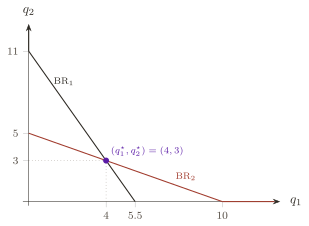
    The first-order condition gives the best-response for the case \( q_2 < 11 \):

    \[ \begin{aligned} 11-2q_1-q_2 &= 0 \\ \Rightarrow\quad q_1 &= \frac{11-q_2}{2}. \end{aligned} \]

    For \( q_2 \ge 11 \), its best response is to choose \( q_1 = 0 \).

    So, the best response function of firm 1 is

    \[ \begin{aligned} \text{BR}_1(q_2) = \begin{cases} \left\{\dfrac{11-q_2}{2}\right\} & \text{if } q_2 < 11 \\ \{0\} & \text{if } q_2 \geq 11 \end{cases} \end{aligned} \]

    Similarly, the best response function of firm 2 is

    \[ \begin{aligned} \text{BR}_2(q_1) = \begin{cases} \left\{\dfrac{10-q_1}{2}\right\} & \text{if } q_1 < 10 \\ \{0\} & \text{if } q_1 \geq 10 \end{cases} \end{aligned} \]
    Cournot Duopoly Equilibrium with asymmetric marginal costs

    Solving the two best responses simultaneously:

    \[ q_i^* = 4, \quad q_2^*= 3. \]

    Total output and price follow:

    \[ q^* = 7, \quad p^* = 5. \]

    Profits are

    \[ \pi_1^* = 16, \quad \pi_2^* = 9. \]

    The lower-cost firm produces more and earns more.